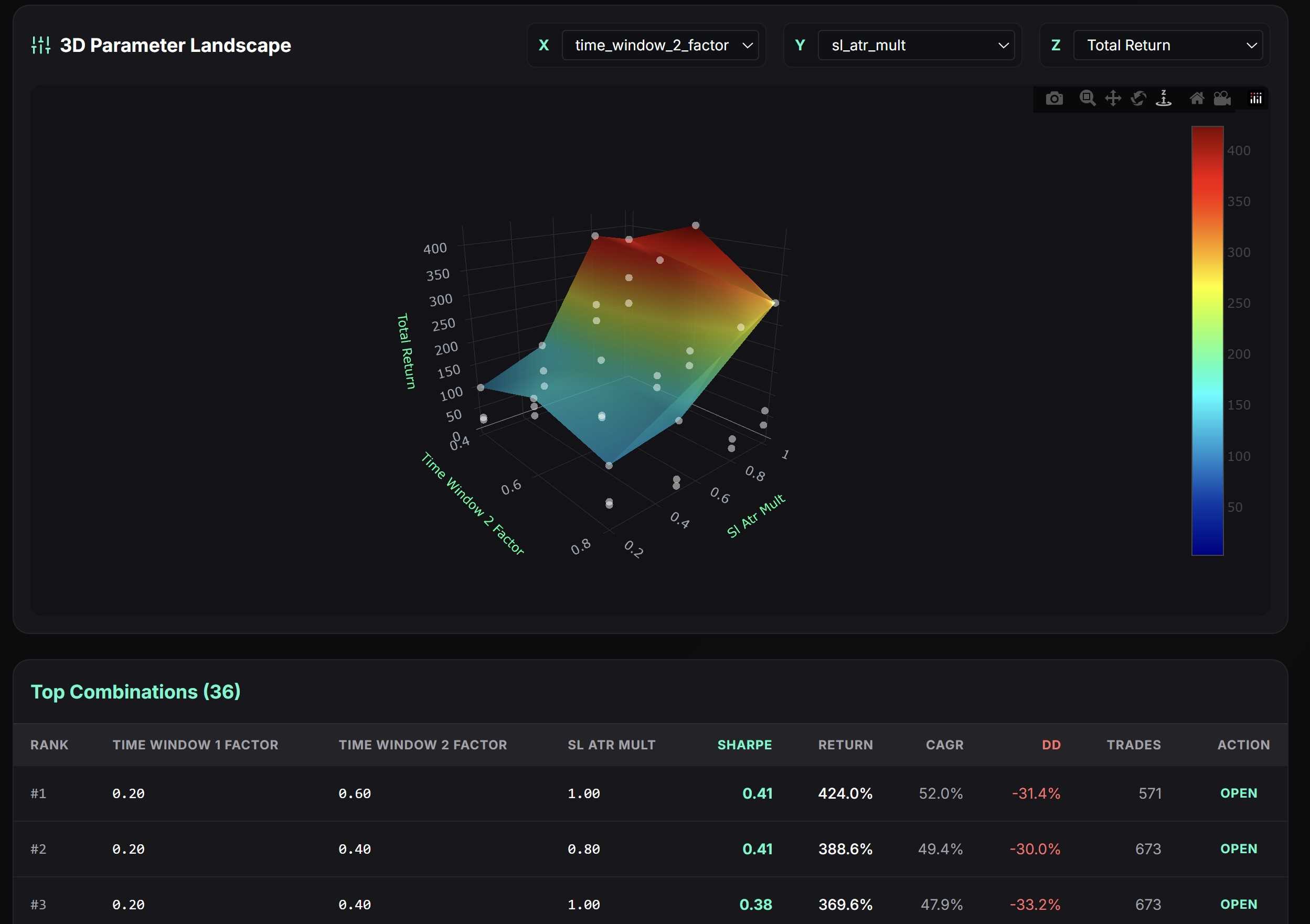
Most backtesting tools are great at producing a nice equity curve. But once you actually deploy a strategy, the curve isn’t the problem anymore.
The problem becomes the gap between “what the backtest says should happen” and “what actually happened in my brokerage account.”
That’s why I’m building my own backtest tool. Not to reinvent charts, but to build a tight loop between research and production.
The Data Gap
The first reason is data. I already have a working pipeline around my broker: instruments I trade, pricing conventions, timestamps, corporate actions, FX conversions, and the general messiness of real markets. I don’t want a separate research universe with slightly different symbols, slightly different sessions, slightly different assumptions. Every small mismatch creates a new place for performance to look good in testing and drift in reality.
Code Consistency
The second reason is code consistency. In a lot of setups, the backtest and the live system are basically two different engines. They may “implement the same strategy,” but they size positions differently, round differently, handle cash differently, or treat constraints differently. That’s not a small detail — that’s a different strategy. I want the backtest and the live trading layer to share the same logic, so I’m not comparing apples to a carefully filtered apple-shaped simulation.
Reconciliation is Key
But the biggest reason is reconciliation. I want to be able to run a backtest alongside the live system and compare them continuously. On any day I should be able to answer: what trades did the strategy expect, what trades actually happened, and why are they different? Was it slippage, partial fills, timing, an order rejection, a missed signal, or a data issue? And what part of PnL came from the strategy itself versus execution friction?
If something diverges, I don’t want to discover it weeks later by staring at performance. I want it to be visible immediately, with a clear explanation.
Building an Operating System
In the end, this is less about building a backtester and more about building an operating system for systematic trading: one pipeline from idea to deployment, and then a monitoring layer that tells me whether the strategy is behaving live the way it behaved in testing.
That’s the real goal: not a prettier backtest, but a backtest I can keep running next to reality.