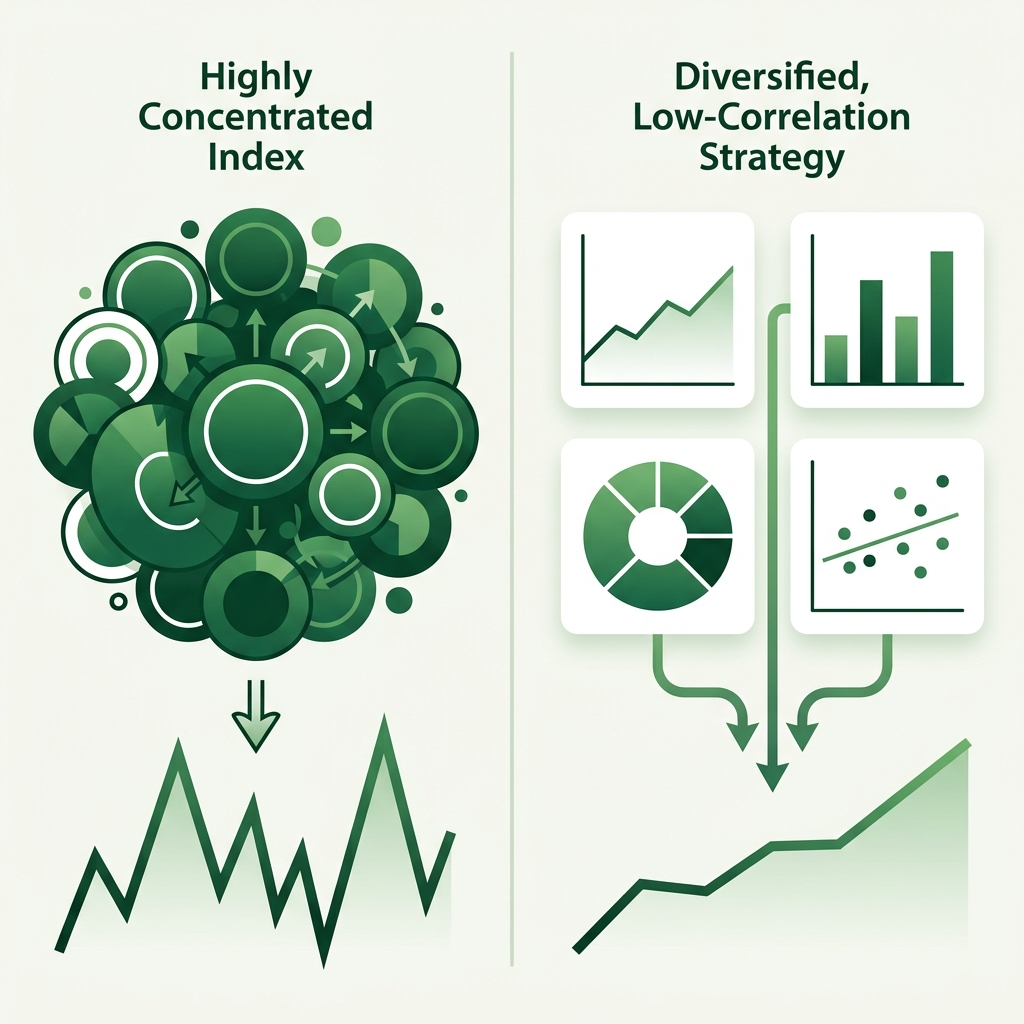
The S&P 500 is currently more concentrated than it has been at any point since 1932.
If you are holding a standard market-cap weighted index fund, you aren’t buying a broad slice of the global economy anymore. You are buying a highly concentrated, levered bet on the continued, uninterrupted outperformance of a very small group of tech companies.
The top 10 stocks now represent a record 41% of the S&P 500 by weight. However, they only account for 32% of its earnings. That is a massive valuation premium. For context, during the peak of the dot-com bubble, the top 10 stocks made up only 27% of the index. Today's market is far more top-heavy than the peak of the greatest technology bubble in modern history.
In 2025, just five stocks accounted for a staggering 45% of the index's total returns. Since 2023, the market-cap weighted S&P 500 has outperformed its equal-weight counterpart by record margins. This tells us one thing: the rally looks broad and healthy on the surface, but underneath it is being carried entirely by a handful of names riding the AI wave.
The Velocity of Concentration
This massive concentration is now riding one of the fastest two-month rallies in market history. The S&P 500 rose 16% across April and May of 2026.
Historically, a two-month run of this scale has only been matched four times since World War II. Three of those instances were violent recoveries out of severe economic crises: the COVID-19 pandemic recovery in 2020, the Great Financial Crisis recovery in 2009, and the recovery in 1975 following the oil shock.
The only exception? The months leading directly into the 1987 market crash.
This current rally came off a 9% geopolitical drawdown, not an economic collapse. That puts the current market behavior in historically unusual, and highly fragile, territory.
Real Cash Flow, Real Risks
To be clear, these mega-cap tech companies are not the phantom businesses of the 1999 bubble. These are high-quality, dominant enterprises with robust fundamentals, generating a combined $350 billion in free cash flow. They are spending on AI infrastructure at a massive scale and maintaining clear monopolies across multiple industries.
But no matter how great the businesses are, concentration risk at this scale is systemic risk.
If you already own an index fund, or if you hold technology stocks, you already have massive, dominant exposure to AI. Adding more AI exposure to your portfolio does not give you diversification. It simply compounds your vulnerability to the same single point of failure.
The Case for Uncorrelated Returns
You do not need more AI exposure. You need more uncorrelated returns.
At Undiluted, we build low-correlation systematic strategies designed to perform in exactly this kind of environment. Our approach is not a directional bet on whether these tech stocks will crash or continue their rally. Instead, we trade short-term inefficiencies, capturing intraday momentum and mean reversion across thousands of automated trades.
By operating with near-zero correlation to the broader indices, we provide true diversification. Diversification is most valuable when it feels least necessary—and in a market this concentrated, it has never been more necessary.
Past performance does not guarantee future results.